
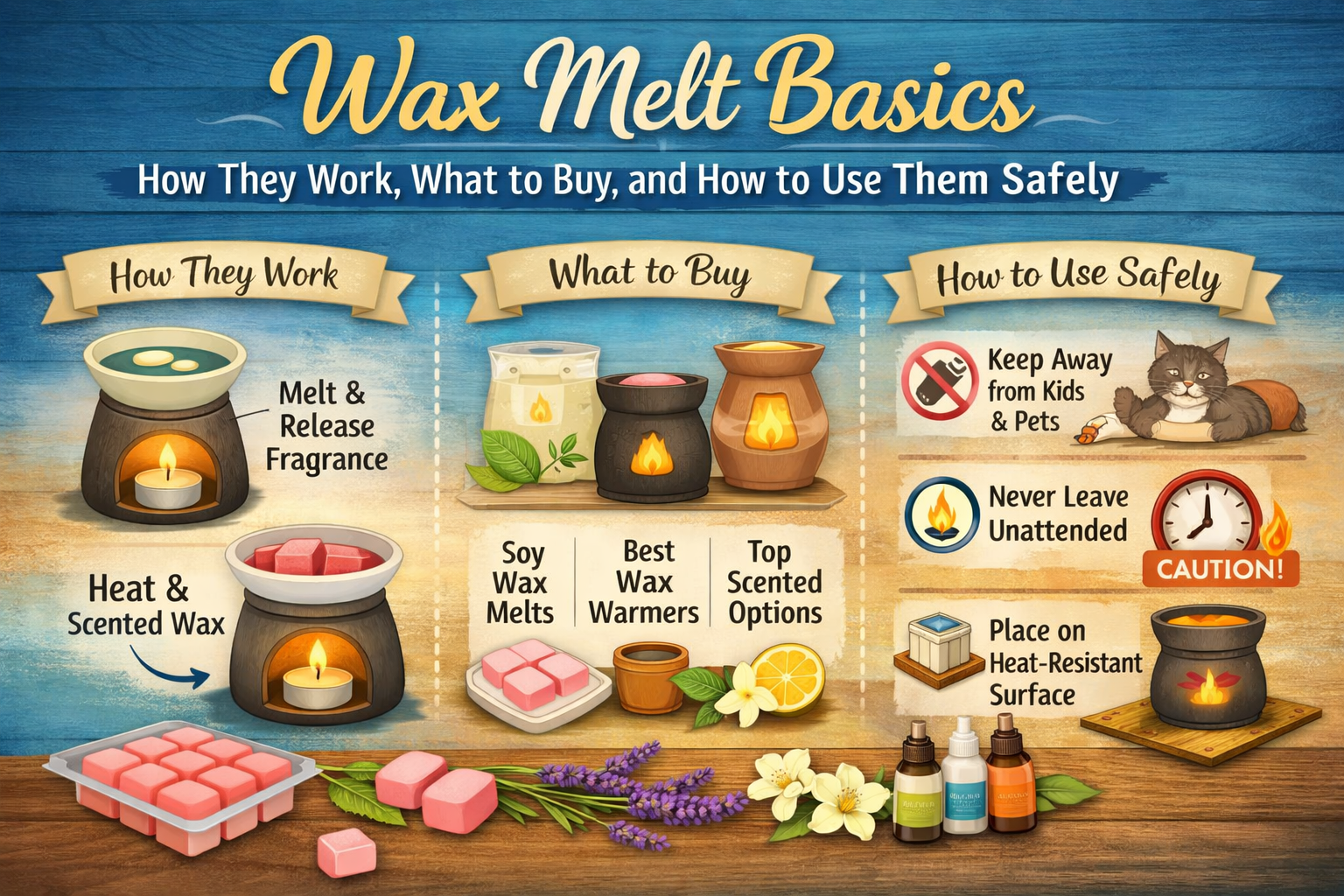
A Wax Melt is a small piece of scented wax that you warm (not burn) to make a room smell good. Instead of a wick and a flame, you place the wax in a warmer, usually an electric one, and gentle heat releases fragrance into the air.
People love wax melts because they’re easy. You can swap scents fast, you don’t have to babysit a candle flame, and the scent can feel stronger than you’d expect from such a small piece of wax.
This guide breaks down how wax melts work, what to look for when you’re buying melts and warmers, how to use them safely, and the simplest cleanup methods when it’s time to change scents.
How wax melts work (and how they compare to candles)
Wax melts work on a simple idea: warm wax releases fragrance oils into the air. You place a cube (or a few) into the warmer’s dish. Heat softens and melts the wax, and the scent rises as the wax warms.
Warmers come in a few common styles:
- Electric hot plate warmers: A small heated plate warms the dish from below. These are popular for steady scent.
- Bulb warmers: A light bulb provides heat, often in a nightlight-style plug-in. They can be great for small spaces.
- Tea light warmers: A tea light candle heats the dish. They work, but they bring back an open flame, which changes the safety story.
You’ll also hear people talk about “throw.” Scent throw just means how far the fragrance travels. A strong throw means you can smell it across the room, or even down a hallway. Throw depends on the melt’s fragrance strength, the warmer’s heat level, the room size, and airflow.
So how do wax melts compare to candles? If you like the cozy glow of a flame, candles win on mood. But wax melts have real advantages for day-to-day use. There’s no wick trimming, no flame, and no soot marks creeping up walls or onto nearby decor.
That said, “no soot” doesn’t automatically mean “no impact.” Scented products can affect indoor air, especially in smaller rooms with closed windows. Some research suggests that heated fragrance (including wax melts) can add volatile organic compounds (VOCs) to indoor air and may also form very tiny particles when fragrance chemicals interact with indoor ozone. If anyone in your home gets headaches, has asthma, or is sensitive to scent, it’s smart to treat fragrance like seasoning: a little can go a long way, and ventilation matters.
Why people love wax melts: strong scent, no flame, and less mess
- Strong scent for the size: Many melts give a bold fragrance without lighting anything.
- No wick work: No trimming, no tunneling, no relighting.
- No soot: You avoid the smoke stains some candles can leave behind.
- Easier scent swapping: Pop out one scent, add another, and you’re done.
- Often cheaper per use: You can re-warm the same wax until it fades.
- Easy to mix: You can blend two scents (like vanilla plus pine) in the same dish.
A quick reality check: fragrance sensitivities and indoor air quality
If scented laundry soap can bother someone, wax melts can too. Common complaints include headaches, nausea, allergy-like symptoms, or a “scratchy” feeling in the throat.
Scientists have also raised concerns that heating scented wax can release VOCs (including terpenes, the compounds that smell like citrus or pine). In certain indoor conditions, those chemicals can react and form ultrafine particles. The takeaway is not panic, it’s control.
A few simple ways to reduce risk:
- Use less wax than you think you need.
- Limit sessions (try 1 to 3 hours, then take a break).
- Crack a window, or run a vent fan for fresh air.
- Skip wax melts in sleeping rooms, especially overnight.
- If you’re sensitive, choose lighter scents (or go fragrance-free).
Choosing the right wax melts and warmer for your space
Shopping for wax melts can feel like picking paint colors. Everything sounds good, then you get it home and it’s either too strong, too weak, or just not you. A practical approach helps: match the wax type and warmer style to your room, your scent tolerance, and how often you plan to switch fragrances.
Wax types and blends, what changes (and what does not)
You’ll see a few wax bases over and over:
Soy wax is still the most common choice in 2026. Many people like it because it’s plant-based and tends to be easier to clean than harder waxes. Coconut wax blends are getting more attention too, often described as smooth and strong, but they can cost more. Paraffin blends remain widely used because they can carry fragrance strongly and are often budget-friendly. Beeswax blends exist, but they’re less common in mainstream melt lines.
Here’s the part many shoppers miss: wax type matters, but fragrance quality and scent load matter just as much. A well-made paraffin blend can smell cleaner than a poorly made soy melt, and a lightly scented soy melt can feel underwhelming in a big, open living room.
Simple buying tips that save money:
- If you want easier cleanup, start with soy or plant blends.
- For large rooms, pick scents labeled strong, or choose a warmer with steadier heat.
- Don’t mix too many bold scents at once. Two is usually plenty.
Packaging matters too. Many melts still come in plastic clamshells, but you can also find bulk packs and some lower-waste options. If you care about trash, look for brands that offer recyclable materials where available, or reduced packaging “sampler” bundles.
If you want a few familiar places to start without getting lost in endless options, brands like Kandessence, Goose Creek.are widely available and make it easy to find replacement bulbs, dishes, and consistent scent lines.
Warmers in 2026: timers, smart controls, and safer everyday use
In 2026, the best warmers focus on control. Look for features that help you avoid “oops, I left it on all afternoon.”
A solid warmer usually has:
- A stable base that won’t tip easily
- A dish that’s easy to remove and clean
- A lower heat option (or a warmer known for gentle, steady heat)
- A timer or auto shutoff
- Compatibility with a smart plug if you want app scheduling
Smart plugs are a simple upgrade. You can set a schedule (like 5:00 to 7:00 pm), then it shuts off automatically. It’s not foolproof, but it helps.
Tea light warmers can look pretty, but they reintroduce an open flame. If you choose one, treat it like a candle, same caution, same rules.
How to use wax melts safely, plus the easiest way to clean up
Wax melts feel low-risk, but warmers still get hot, and melted wax can spill. The goal is a good scent without making your countertop a hazard.
Start with placement. Put your warmer on a flat, heat-safe surface, away from curtains, papers, and shelves where wax could drip onto something below. Keep it away from kids and pets, and don’t place it near an edge where a tail, backpack, or elbow can knock it over.
For run time, most people get good results in short sessions. Try 1 to 3 hours to start. If you’re using a tea light warmer, keep sessions shorter and never treat it as “set it and forget it.” Even with electric warmers, don’t leave them on while you sleep, and unplug when you’re done.
Simple step-by-step: getting a good scent without overdoing it
- Add 1 to 2 cubes to the dish (use half a cube for small bathrooms or bedrooms).
- Turn the warmer on and wait 15 to 30 minutes for the scent to build.
- If it’s too light, adjust next time by adding a little more wax, not by stacking cube after cube in one session.
- When the scent fades, stop warming that wax and swap it out.
For big spaces, placement matters as much as wax strength. A warmer tucked behind a sofa won’t scent an open floor plan the same way one placed closer to the center of activity will.
Cleanup and troubleshooting: removing old wax and fixing weak scent
The easiest cleanup is the “cool and pop” method. Turn the warmer off, let the wax fully harden, then gently lift it out. If it won’t release, the freeze trick helps: chill the removable dish briefly, and the wax often shrinks enough to pop out.
If the wax is still warm (not hot), you can also use cotton balls to soak it up, then toss them in the trash. For removable dishes, wash with warm, soapy water once the wax is gone. Never soak electrical parts or let water run into the warmer base.
Quick troubleshooting:
- No scent: The wax is used up, the room is too large, or you’ve gone nose-blind. Swap wax, move the warmer, or take a scent break.
- Too strong: Use less wax, shorten the session, and add ventilation.
- Wax seems too hot: Turn it off and check that the warmer is meant for wax melts, and that the dish isn’t overfilled.
Conclusion
If you want fast, swap-able home fragrance and you prefer no open flame, wax melts are a good fit. They’re simple to use, easy to customize, and they can scent a space quickly with very little effort.
Keep the basics tight: place the warmer on a stable surface, use a timer or auto shutoff when you can, and unplug after use. If anyone in your home is sensitive to fragrance, use less wax and add ventilation so the scent stays comfortable.


Leave a Reply